ALL YOU NEED TO KNOW ABOUT THE OKPE UNION!





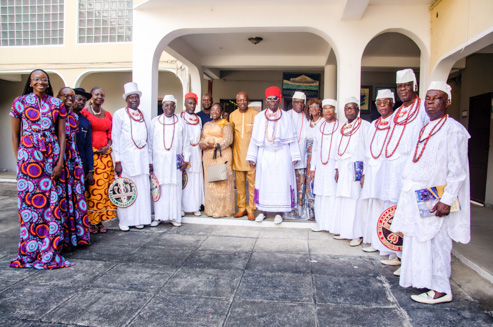
Esezi I, the first Ekweri, was reputedly wicked. The three other houses—Orhue, Evbreke and Orhoro—conspired, assassinated the king, and waged war against the Esezi house, forcing them to flee Orerokpe (then called Adane Okpe).
Later, the three victorious houses fell into dispute. Their conflict devastated Orerokpe, and by around 1780 the town was abandoned for 150 years.
During this exile the Okpe founded two successive capitals. The first arose at Ugolo about 1840, and Idiemor was elected clan head. A feud soon erupted between Idiemor and the Amuokpe house, led by Orholor, resulting in Orholor’s death.
Odjegba, Orholor’s son, declared independence. Because his mother was Itsekiri, he secured Itsekiri allies and defeated the Ugolo Okpe, capturing many and selling them into slavery.
Eventually the Okpe reconciled, deposed Idiemor, and moved the capital from Ugolo to Odjedi in 1890. They also made peace with the Esezi house, electing the oldest man—Anovwan of Ughoton—as the Okpaku Okpe, head of all Okpe. Anovwan’s otota was Odiete son of Owhebor of Oha, and his chief executioner was Okolo of Orhue house. Senior members of the Odjedi government included Odjegba of Amuokpe, Kogoro of Arhagba, Agbaifo of Aghalokpe, and Edjebba of Iriama.
In 1897, Odogun chief Eyaju murdered a woman. The British, having arrived, demanded Eyaju’s surrender. The Odogun refused, citing native law, so British forces dissolved the Odogun, arrested Eyaju, and deported him to Calabar, ending the Odjedi government.
With disunity, outsiders attacked. In 1898 Ikweghwu of Agbarho kidnapped an Oha girl, sparking a bloody war settled only when the Osuivie of Agbarho buried a live goat (the Ochurhobo oath).
Further conflicts followed: Oha vs. Ovu (1919) and, in 1927, British taxation prompted Chief Egbele of Onyeke to revive the Odogun at Odjedi, declaring himself head of all Okpe and refusing to pay taxes. His government was supported by Temisan, Mujakporue, Echerusi and others, but three senior Okpaku—Kogoro, Agbaifo and Akalusi—rejected it and established a rival Odogun at Orerokpe.
The Edion oracle instructed Owhere to perform a sacrifice. Chief Ayomanor of Owhere carried it out, rebuilt his house in Adane, and became factional head of the Okpe in Orerokpe. Egbele’s faction eventually reconciled with Ayomanor, and under British protection the complete Odogun reconvened at Orerokpe in 1931, officially recognized and gazetted in 1934.
It is pertinent to give some ethnographical background of the Okpe, for the reasons that such ethnographical frameworks inform musical philosophy, creativity and practices and would therefore enhance our understanding of Igoru music. The Okpẹ country is situated at the heart of Delta State of Nigeria within latitude 6o and 5o North and longitude 5o 501 and 6o 251 East (Onigu Otite, 1973: 4). It occupies a large expanse of landmass about 500sq kilomitres of mainland, mangrove, swamp and rivers (Otite, 1982: 121). It is politically divided into Okpe and Sapele Local Government Areas of the state. Within the confines of this location, Okpẹ shares borders with Warri, Uvwie (Effurun), and Agbarho on the Southwest. On the Northeast axis, it has boundary with Oghara, Jesse, Benin and Agbon.
The Urhiapẹlẹ River, Ethiope River and the Warri River mark its boundaries somewhat. It is one of the 374 ethnic groups in Nigeria (Otite, cited by David Dafinone, 2000: 8 [Internet\). Among the other ethnic groups in Delta State, the Okpe have the largest kingdom and highest population density up to 248, 314 in 1991/1992 census commission report (Onokerhoraye, 1995: 48).
It should be noted that some authors use the colonial political grouping that put the Okpe together with other Urhobo clans in the former Urhobo Division and discuss its population as such. Some of these authors therefore claim that “the Urhobo people are the 5th largest ethnic group in Nigeria and constitute the largest single ethnic group in Delta State (www.urhobo.org, author’s names not in the article), or claim that “In land area, Urhobo is larger than Switzerland (Dafinone, 2000: 3 [Internet]).
The illustrious kingdom of Okpe as history recalls had four sons: Orhue, Orhoro, Evwreke and Esezi. These four Okpe ruling houses later decided to adopt a rotational system to produce a ruler for the kingdom. This has helped to stabilize peace and social equality in the kingdom till date.
The first king produced by this system was H.R.M. Esezi I, Orodje of Okpe whose sovereignty was around the period of 1770-1779.
H.R.M. Esezi II became the second Orodje of Okpe. A visionary and highly idealistic monarch who believed in the system of democracy. As a pioneer advocate of democracy in the land of okpe, he also was pivotal to Nigeria. He was amongst delegates of Kings that attended the 1957 Lyttelton Conference held in London in order to seek the Nigerian independence from the indirect government of the colonial master. He ruled the kingdom around the period of 1945-1966.
H.R.M Orhoro I, the third Orodje of Okpe ruled the kingdom from around the period of 1972-2004. He was educated at a catholic school and also served in the Nigeria police force. He later earned a Business Administration Diploma in the United Kingdom. His early life experience served him well as a springboard for establishing and becoming a director of a company, the New Africa Industries Limited. He was a worthy and peace-loving monarch that held several other public posts. One of his sons, Prince (Amb) Godwin E. Ejinyere serves as the current Mayor (LGA Chairman) of Okpe Local Government Area.
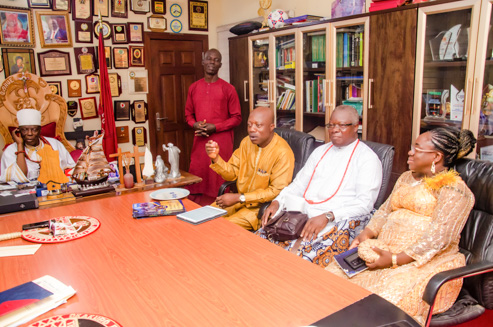
H.R.M Mujakperuo Orue I Orodje of Okpe is the fourth and current king of Okpe. He is a worthy monarch that served his nation as a high-ranking major general in the Nigerian Army. There is great expectations of the greatness his monarchy will add to the already illustrious history of the kingdom of Okpe.
